The timer is counting down, the dog is on the wrong side of the tree, one child has announced that he is not doing this, and you have four seconds to get back into the frame. That is the normal working condition of a family Christmas card shoot, and it is why so many of them look tense. People blame the children, or the camera, or the dark front room. Usually it is all three at once.
The frames that actually end up on the card are almost never the ones anybody planned. They come from the third or fourth attempt, after the arrangement has collapsed and everyone has started laughing at it. So the order of work is the room, then the light, then the grouping, and only then the pose.
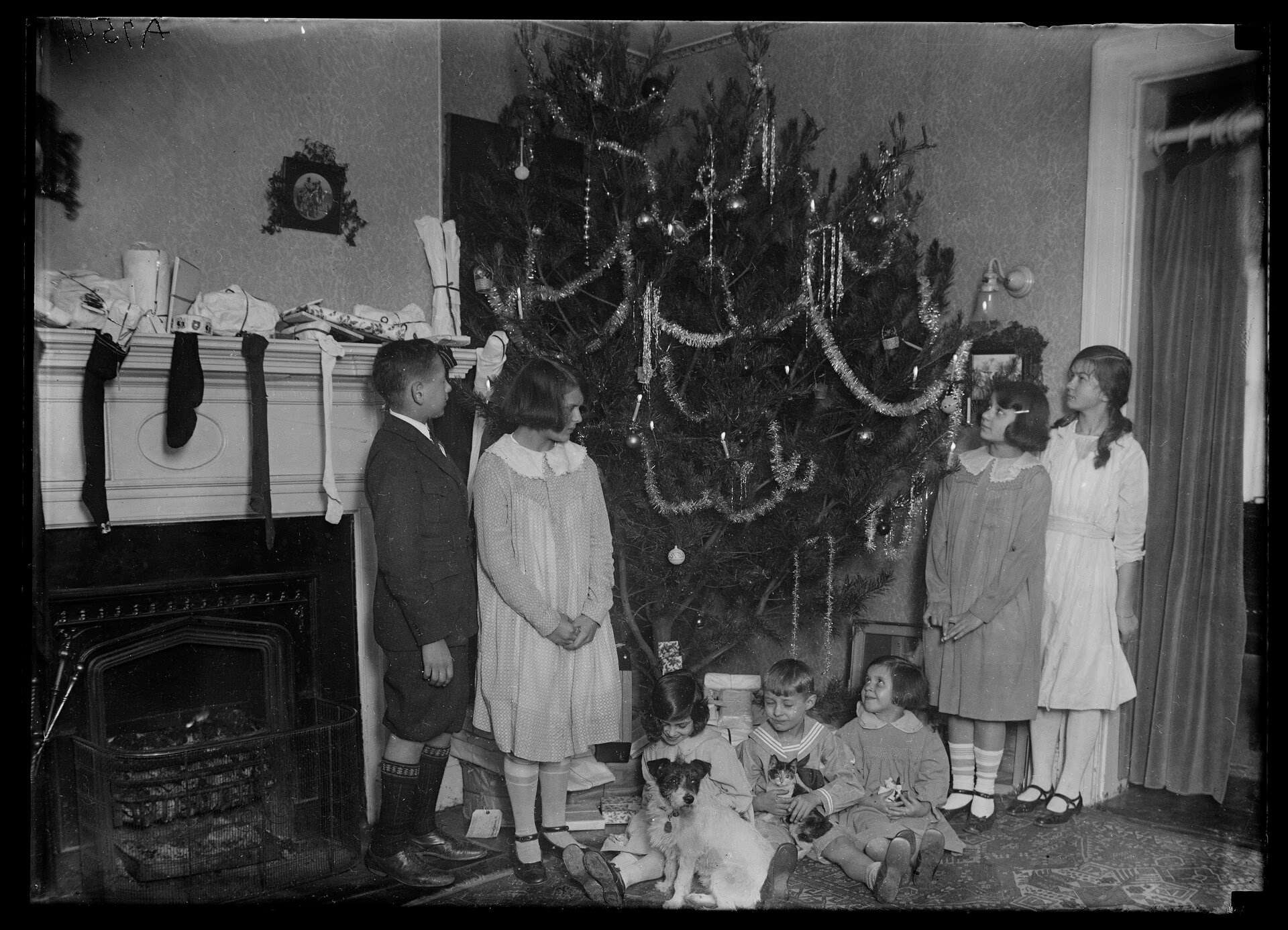
Fix the Light Before You Move Anybody
Switch off the ceiling light. Overhead domestic lighting is the most reliable way to make a Christmas photograph look grim, because it drops hard shadows under every eye socket and flattens the tree into a wall of green. Keep it off unless you want the whole room visible at the cost of every face in it.
Stand the tree behind and slightly to one side of the group so the glow lands on shoulders and hair instead of silhouetting heads. Then find the nearest window, turn the family to face it, and put one warm lamp on the opposite side at about head height. That gives you a two-source setup made from things already in the house.
Tree lights are an exposure decision. Expose for the room and the bulbs turn into white blobs with no colour left in them. Expose for the faces and let the lights burn slightly, or drop a third of a stop and lift the shadows when you edit. A body built for family portraiture holds focus in light this dim where an older camera starts hunting, which matters when nobody is standing still.
Thirteen Arrangements That Hold Together
Good groupings are geometry more than posing. Stagger the heights, break the straight line of shoulders, and give people somewhere to put their hands.
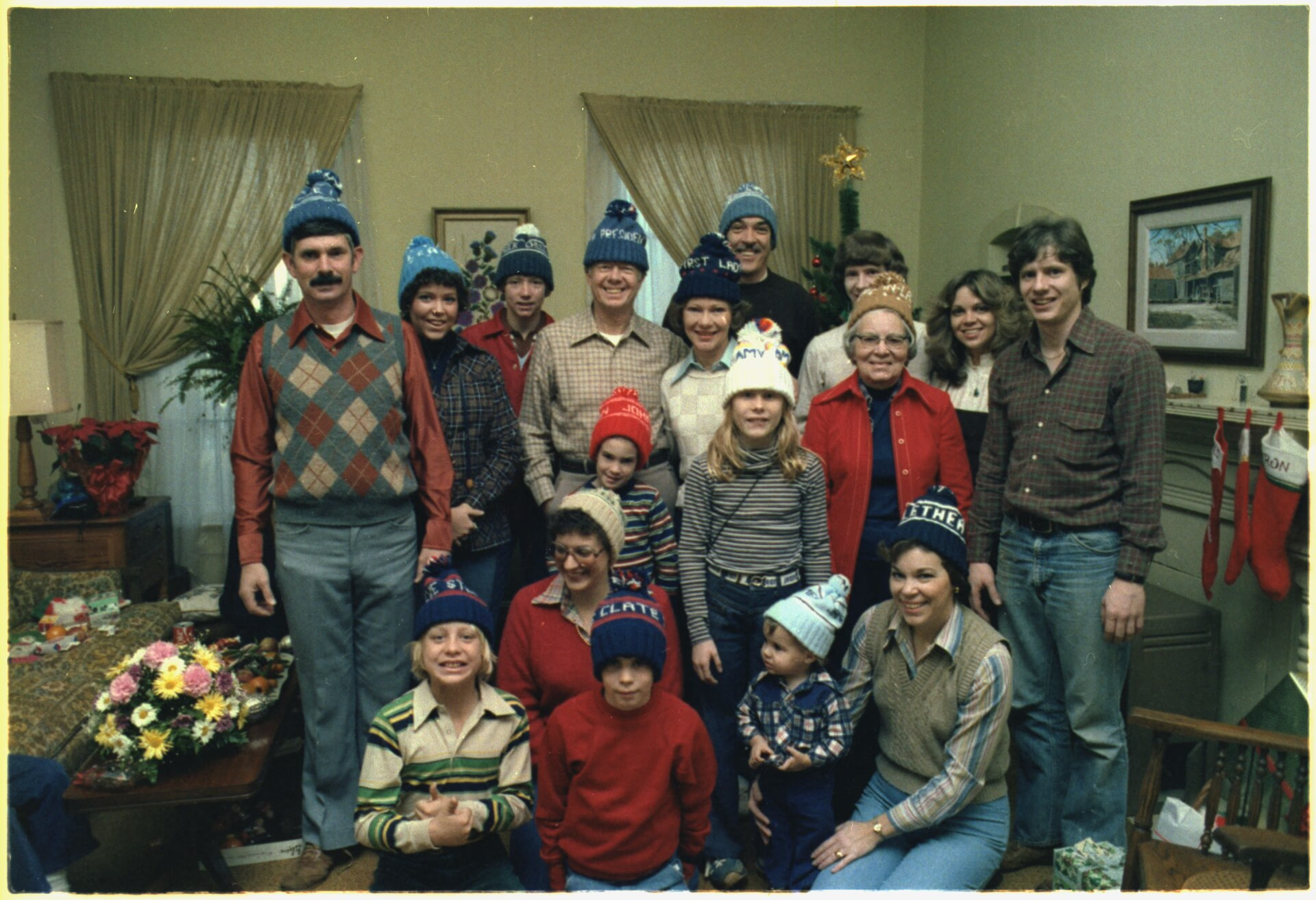
1. Matched Jumpers and a Controlled Palette
Full matching outfits read as costume, which is part of the charm for some families and a hard no for others. If you want the coordinated look without the uniform, pick two or three colours and let everyone choose within them. Denim and cream, or red and grey, survive a bad indoor white balance better than pastels do.
2. Gathered Around the Tree
Cluster the group so the tree occupies the back third of the frame rather than standing as a wall behind them. Have one or two people sit or kneel at the front so the height line staggers. Leave a little air above the tallest head, otherwise the composition presses down on everybody in it.
3. Sitting on the Stairs in Height Order
Stairs solve the staggering problem for you, and they give each person an edge to rest on so nobody sags into a slouch. Put the shortest bodies low and the tallest at the top, then rotate shoulders slightly toward the camera instead of squaring up. Shoot from below only if the staircase is wide, because a steep upward angle makes the front row look enormous.
4. The Look-at-the-Camera Shot, Given a Job
The straight group shot fails because people have nothing to do but stare. Hand out tasks instead. One person holds the newest baby, one holds a mug, two pull a cracker between them. Hands that are busy stop fidgeting, and the picture stops looking like an identity parade.
5. Piggyback Stacks
An older sibling carries the younger one, or a parent carries the smallest. It reads as affection rather than arrangement, and it staggers the heights for free. Shoot it quickly, because the carrier's arms give out fast and the expression that follows is rarely the one you wanted.
6. The Front Porch
Step outside the front door. Porch light plus daylight gives clean skin tones, and the doorway frames the group without any posing at all. This works in a cold climate if you accept that you have about ninety seconds before everyone's face changes.
7. Blankets Outdoors
One large blanket over several laps forces people close together, which is a grouping trick disguised as a prop, and it handles the cold at the same time. Sit at their eye level rather than standing over them. Check that the blanket is not swallowing hands and feet whole, or the group will look like it is sinking.
8. The In-Between Frame
The shot you use is usually the one taken two seconds before or after the posed one, while somebody is mid-laugh or being told where to stand. Keep shooting through the rearranging. Resist deleting these on the back of the camera, because they often look like nothing on a small screen and like everything on a monitor.
9. The Group Shot With a Pet
Put the dog where it will actually stay, usually at the end of the line or in the lap of the person it follows around the house. Nominate one person to be responsible for the animal and nobody else. A slightly blurred tail beats a sharp photograph of a dog being restrained.
10. Matching Pyjamas and Baking
Pyjamas plus a kitchen give the group a job with visible results, and the mess is part of the warmth. Shoot at counter height, keep the oven light and the window as your two sources, and expect flour on the floor in every frame you keep. Nobody has to be told to look cheerful in this one, which is exactly the point.
11. The Sofa Row
A sofa stacks people into a tight line with the taller ones standing behind. Turn every set of knees toward the same corner rather than straight at the lens, and use a cushion as an excuse for somebody to lean. Watch whoever ends up squeezed against the armrest, because that person's expression carries the whole frame.
12. Overhead on the Bed
Lie-on-the-bed shots work well with children and read as unstructured rather than staged. Get up on something safe so the camera is genuinely above them, shoot straight down, and keep the flash off. Bedroom window light is usually enough, and it suits the mood better than anything you could add.
13. The Walk Up the Drive
Walking shots remove the stiffness problem entirely, because nobody has time to pose while moving. Walk the group toward you, shoot continuously, and pick the frame where the feet are in a natural rhythm. This is the fallback when a family simply will not hold still for anything else.
White Balance with Christmas Lights in Frame
Mixed light is the technical problem of the season. Tungsten lamps, LED tree lights, a fire and a cold window all sit inside one frame, and no single white balance setting fixes all four of them. Choose the source that is lighting the faces and let the tree stay warm. Orange tree lights look wrong the moment you neutralise them.
If skin tones come out green or magenta, that is the camera reacting to a mixed scene rather than a fault in your settings. Shoot raw so you have room to move, and correct the faces only. A quick colour correction pass that targets skin and leaves the background alone is usually all it takes.
Timing, Self-Timers, and Blinks
Somebody blinks in every group shot, so take at least five frames and expect to use the fourth. Ten seconds is plenty of self-timer. Twenty seconds is a guaranteed loss of attention, especially with anyone under six in the picture. If you can use a remote release or a phone app instead, do, and then shoot from inside the group rather than from behind the camera.
Focus is where most of these frames quietly fail. A camera with autofocus that copes with children and eye detection earns its keep in a room full of moving heads, and the keeper rate goes up immediately. Set enough depth of field to cover the front and back rows, because at f/1.8 the second row is soft and nobody notices until the cards arrive in the post.
What to Wear
Avoid fine stripes, small checks and busy graphic prints, which shimmer and pull the eye away from faces. Big blocks of pure white and pure black are hard to hold detail in, so off-white and charcoal behave better. Shoes matter less than most people think unless you are shooting full length on a porch, and bare feet in a December picture usually look like an oversight rather than a decision.
Printing and Sending
Decide the card format before the shoot, because a square or portrait crop changes how you compose the group. If the card runs 5x7, leave margin around everyone instead of filling the frame, and keep faces out of the outer edge where the trim falls.

Check the file at full size before ordering a hundred copies. Dark indoor photographs look acceptable on a phone and muddy on card stock, so lift the shadows a touch more than feels right on screen, and proof a single copy first if the printer offers it.
Tips for a Christmas Card Shoot
- Take more frames than you think you need, and expect the fourth or fifth to be the one.
- Kill the ceiling light and open the curtains before you move anybody into position.
- Stagger heights so no two heads sit at the same level in the frame.
- Give every person a job for their hands, even if it is only holding a mug.
- Shoot the in-between moments, because that is usually where the keeper lives.
- Promise the youngest person something worth having, and pay up immediately afterwards.
- Shoot one extra arrangement after everyone believes you have finished.
Conclusion
The pose is the smallest part of the job. Light first, then the grouping, then a shutter release you are not racing against. Families who look relaxed in a card photograph are usually just families who were given something to do and then photographed while they did it.
Expect to shoot a lot and keep very little. Twenty minutes, a hundred frames and one good one is a normal and successful session. The card only needs a single picture that looks like your family rather than a group of people enduring a photograph.
FAQ
How many poses should I shoot for a Christmas card?
Plan three or four arrangements and run each one several times. Working through a long list wears everyone out, and the last two arrangements are always the weakest of the day.
Should I use flash for indoor Christmas photos?
Usually no. Bounced flash can work in a bright room, but direct on-camera flash kills the glow of the tree and flattens faces. Window light with a warm lamp on the far side is more forgiving and reads like a home rather than a studio.
What colours should a family wear for Christmas photos?
Two or three coordinated colours rather than identical outfits. Reds, creams, deep greens and denim all work indoors. Skip busy prints, skip pure white, and avoid dressing everyone in the same shade of the same colour unless you want a uniform.
How do I stop everyone blinking at once?
Take a burst of five frames rather than one, and ask people to close their eyes and open them on a count of three. It sounds silly and it works, because it resets a group that has already blinked twice.
How long should a Christmas card shoot take?
Twenty to thirty minutes with a cooperative family, and less if small children are involved. A long session produces more frames but not better ones, because attention drops after the first few arrangements.
Can I take a Christmas card photo with a phone?
Yes, and in a bright room with the ceiling light off it will hold up fine. Use the main camera rather than the front one, shoot raw if the phone allows it, and keep the phone level instead of tilting it for the tall people at the back.