The 35mm focal length has long been a favorite among photographers for its natural, true-to-life perspective and remarkable versatility. Whether you're documenting a wedding, capturing candid family moments, or wandering city streets for some urban photography, a good 35mm prime can feel like the only lens you need. The Nikon 35mm f/1.8G ED makes a compelling case for being exactly that lens — especially when you consider what it delivers for the price.
In this review, I'll walk you through my real-world experience using the Nikon 35mm f/1.8G ED on a full-frame Nikon body. Rather than studying test charts, I want to show you how this lens performs in actual shooting situations and why it deserves a spot in your camera bag, whether you're a working professional or a passionate enthusiast.
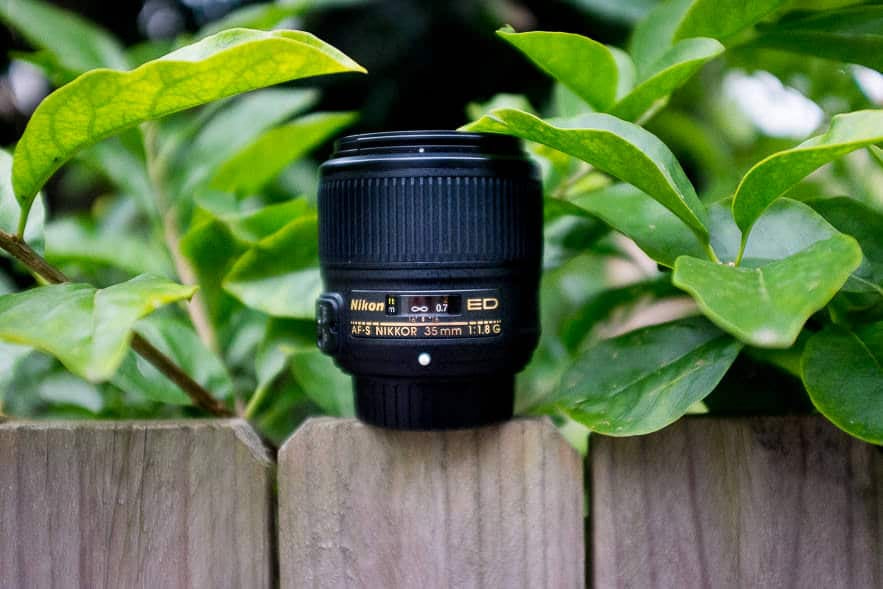
Why Choose the Nikon 35mm f/1.8G ED?
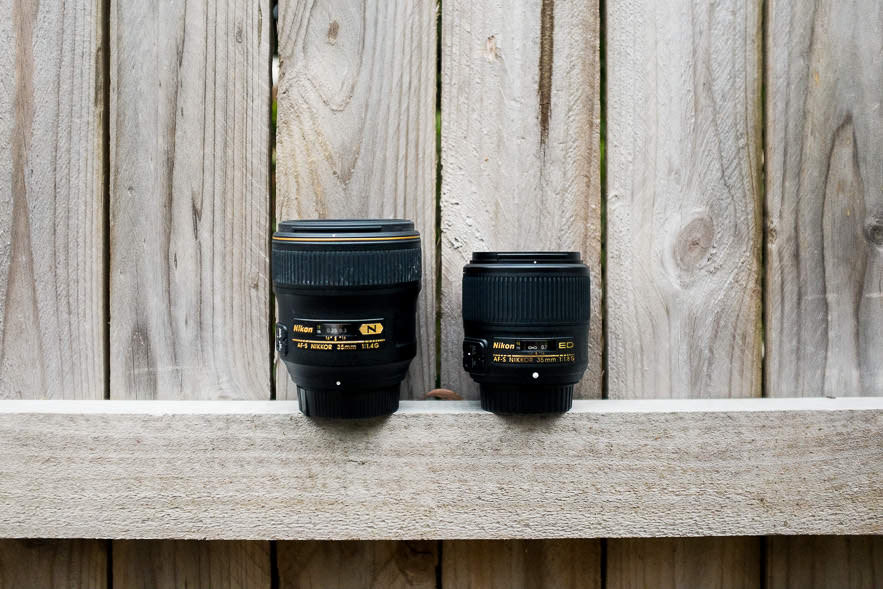
If you already own Nikon's flagship 35mm f/1.4G, you might wonder why anyone would bother with its more affordable sibling. The answer is surprisingly practical. As a wedding photographer, I carry backups of almost everything — spare camera bodies, extra flashes, and backup lenses. But here's the thing: few photographers I know carry an identical duplicate of an expensive lens. The Nikon 35mm f/1.8G ED solves this problem beautifully. It's roughly one third the price of the f/1.4G, half the weight, and compact enough to slip into a jacket pocket.
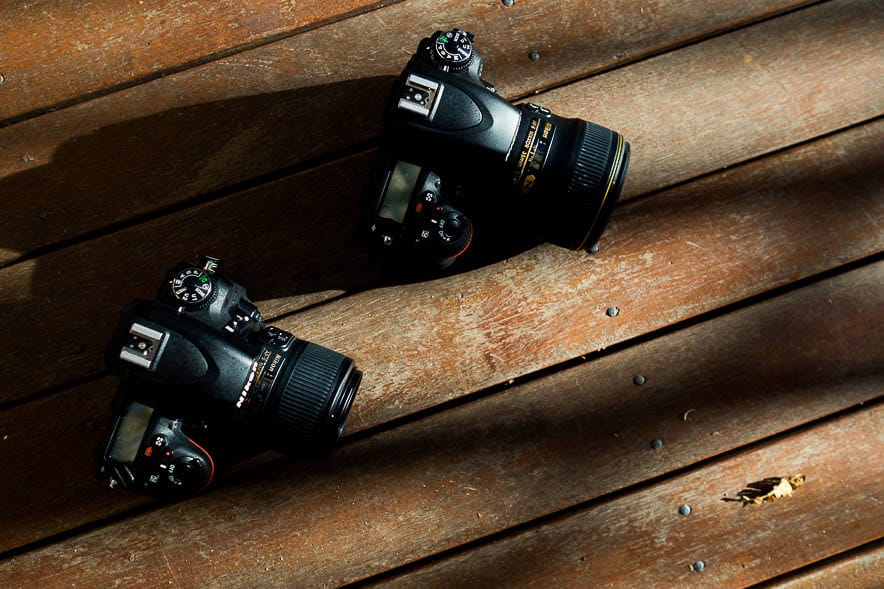
Beyond serving as a backup, this lens has become my go-to everyday optic. I pair it with my Nikon D750 when heading out with family or friends. The combination feels balanced and natural in the hand — the weight sits comfortably in the camera body rather than pulling forward like a heavy f/1.4 setup. Every time I use this setup, I'm practicing with the gear I rely on professionally, which builds muscle memory and familiarity that pays off during paid shoots.

Build Quality and Handling
To hit a lower price point, manufacturers often cut corners on build quality. Nikon took a smarter approach with the 35mm f/1.8G ED. The exterior is made of hard plastic, but the lens mount is metal with a rubber gasket that provides decent sealing against dust and moisture. It feels solid in the hand, not flimsy.
One minor drawback worth noting: the filter thread is plastic, so if you frequently swap filters on and off, there's a small risk of the threads wearing down over time. That said, in everyday use this hasn't been a significant issue. The manual focus ring deserves special mention — it's wide, well-textured, and smooth to operate, making precise manual adjustments a genuine pleasure.
Size and Weight Advantages
At just 305 grams (10.7 ounces), the Nikon 35mm f/1.8G ED is remarkably light. Compare that to the 600-gram Nikon 35mm f/1.4G, and the difference is immediately noticeable when you're carrying a camera for hours at a time.
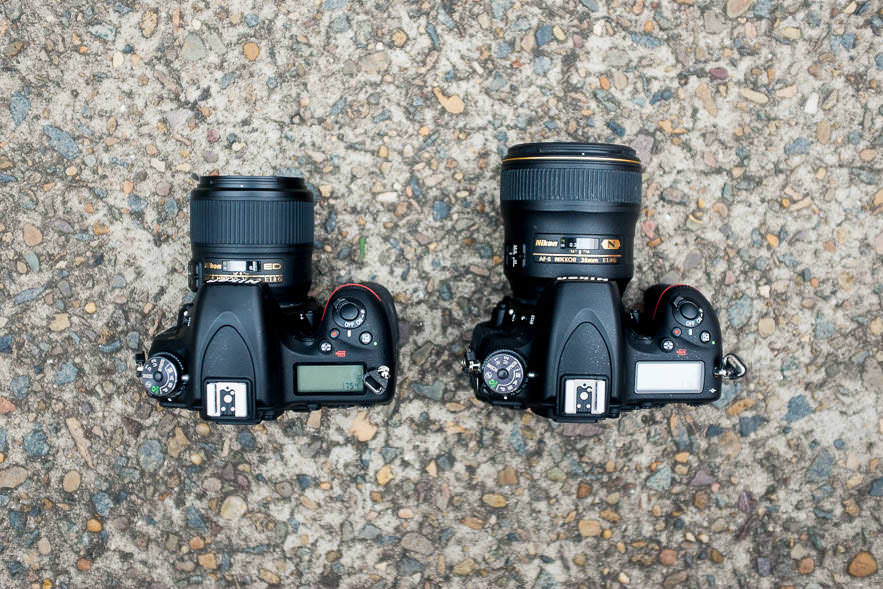
The lens is also compact enough that I can fit the entire camera-and-lens combination into a jacket pocket — something that's simply impossible with the bulkier f/1.4 version. For travel, street photography, or simply reducing the load during a long shooting day, this size advantage is hard to overstate.
Image Quality: How It Compares to the f/1.4
Let's address the obvious question: does the f/1.8 version match the image quality of the f/1.4G? No, and that shouldn't surprise anyone. But the gap is much smaller than you might expect.
The Nikon 35mm f/1.8G ED features 7 diaphragm blades versus the 9 blades found in the f/1.4G. This means the bokeh on the f/1.8 is slightly more structured and less buttery-smooth when shooting wide open.


However, the out-of-focus rendering is far from distracting, and in many real-world scenes, you'd be hard-pressed to tell the difference without a side-by-side comparison. Interestingly, the f/1.8G is actually sharper than my copy of the f/1.4G, which is fairly common — f/1.8 lenses are often optimized for sharpness, while flagship f/1.4 lenses prioritize a more pleasing rendering character. The single Extra-Low Dispersion (ED) element helps deliver crisp, contrasty images with minimal chromatic aberration.

Flare performance is another pleasant surprise. When you stop down the aperture, the sunstars and flare patterns have real creative character without becoming overwhelming — a bonus for backlit portraits and golden-hour shooting.

Autofocus Performance
Thanks to Nikon's Silent Wave Motor (SWM), autofocus is fast, accurate, and nearly silent. Because the internal lens elements are lighter than those in an f/1.4 design, the focusing group moves more quickly — the lens snaps from close focus to infinity noticeably faster than the bigger f/1.4G.

This quiet operation is a real advantage when shooting in hushed environments like churches, ceremonies, or intimate gatherings where a loud focusing motor would draw unwanted attention. In low-light conditions, the lens locks onto subjects with confidence, keeping up with the demands of fast-paced shooting scenarios.
Real-World Sample Images
Here are a few more shots taken with the Nikon 35mm f/1.8G ED, all processed with modest contrast and sharpening adjustments for web display. These images reflect what you can expect from this lens in day-to-day use.



Practical Tips
- Shoot wide open at f/1.8 for subject isolation and beautiful background separation. The sharpness holds up well even at maximum aperture.
- Stop down for sunstars. When shooting into the light, try f/8 or f/11 for attractive, well-defined sunstars that add a creative edge to your compositions.
- Pair with a full-frame body for the most balanced handling. The weight distribution feels natural and doesn't tire your hands during all-day shoots.
- Consider the DX version if you shoot with a cropped-sensor Nikon body. The Nikon 35mm f/1.8G DX offers similar performance at an even lower price.
- Use a protective filter if you swap filters often. Since the filter threads are plastic, keeping a clear filter permanently attached can help extend the lens's lifespan.
Conclusion
The Nikon 35mm f/1.8G ED is one of those rare lenses that delivers far more than its price tag suggests. It's sharp, lightweight, fast-focusing, and produces images with genuine character. Whether you need a reliable backup for your professional kit or a lightweight everyday prime that won't weigh you down, this lens deserves serious consideration.
When I'm not shooting weddings with my f/1.4G, the 35mm f/1.8G lives on my camera. That's probably the strongest endorsement I can give.
---
FAQ
Is the Nikon 35mm f/1.8G ED compatible with full-frame cameras?
Yes, this is an FX-format lens designed for full-frame Nikon DSLRs. It also works on DX (cropped sensor) bodies, where it provides an equivalent field of view of roughly 52mm — a classic normal perspective that's excellent for everyday photography.
How does the Nikon 35mm f/1.8G ED compare to the f/1.4G version?
The f/1.4G produces slightly creamier bokeh and has superior weather sealing, but the f/1.8G is actually sharper, significantly lighter, much more affordable, and focuses slightly faster. For most photographers, the f/1.8G is the more practical choice.
Is this lens suitable for wedding photography?
Absolutely. A 35mm prime is one of the most versatile focal lengths for weddings, handling everything from environmental portraits to detail shots and reception candids. Many professional wedding photographers use this exact lens as their primary or backup 35mm option.
Does the lens have image stabilization (VR)?
No. Like most fast prime lenses from Nikon's F-mount era, the 35mm f/1.8G ED does not feature Vibration Reduction. The wide f/1.8 aperture helps compensate by allowing faster shutter speeds in low-light situations.
What filter size does the Nikon 35mm f/1.8G ED use?
The lens accepts standard 58mm screw-on filters, which is a common and affordable filter size shared by several other Nikon lenses.